

Access gets you aboard. Ownership puts you in control.
There are four common ways to fly privately: on-demand charter, jet cards, fractional programs, and whole-aircraft ownership. Each solves a different problem. For travelers who fly only occasionally, charter can be the sensible answer. But for those who repeatedly fly the same kinds of trips, value consistency, or want the aircraft available on their terms, ownership can become compelling at far fewer annual hours than conventional wisdom suggests.
Break-even depends on the aircraft, acquisition cost, financing, maintenance position, crew structure, trip pattern, and whether capital cost and depreciation are included. The charter example reflects a quote received in 2026; current pricing and aircraft availability will vary.
Every option exchanges cost for a different level of control.
Charter
Book an aircraft when a trip arises and make no long-term commitment. Charter works well for occasional use, changing passenger needs, or travelers who do not want the responsibilities of ownership.
The tradeoff is variability. Aircraft, crews, pricing, and availability can change from one trip to the next. Repositioning, daily minimums, peak periods, and one-way economics can also make the final trip cost much higher than the advertised hourly rate.
Jet card
A jet card simplifies charter by placing funds or flight hours into a defined program. It can provide more predictable service, pricing, and availability than shopping each trip independently.
The convenience comes at a premium, and the aircraft is still drawn from a fleet rather than being your own. Program rules, peak-day restrictions, minimum flight times, service areas, and rate adjustments remain important parts of the equation.
Fractional
Fractional programs provide access to a professionally operated fleet in exchange for an aircraft share or lease, monthly management fees, and occupied hourly charges.
They offer consistency and strong dispatch capability without requiring the owner to manage an individual aircraft. The tradeoff is cost and control: you pay for premium fleet access, do not choose the specific aircraft assigned to each trip, and exit under the program's terms rather than selling an aircraft directly on the open market.
Ownership
Your aircraft, selected around your mission and operated to your standards. Ownership provides the highest level of control over scheduling, crew consistency, cabin setup, maintenance philosophy, baggage, pets, and the overall travel experience.
For the right mission and utilization, especially with a carefully selected legacy Citation, ownership may also produce a lower real trip cost than repeatedly purchasing the same lift through charter, jet-card, or fractional programs.
The mission matters more than a generic hourly threshold.
The traditional advice that ownership begins around 100 or 150 hours per year is too broad to be useful. A traveler purchasing short, competitively priced local charter has a very different equation from an owner repeatedly paying for long round trips, repositioning, peak travel, or aircraft that must remain away for several days.
Ownership can begin to compare favorably around 35–50 annual flight hours when several of these conditions apply:
- You regularly fly the same repeat missions.
- Your trips are primarily round trips from a consistent home base.
- Charter quotes include substantial repositioning or overnight costs.
- You frequently travel during holidays or other high-demand periods.
- Schedule reliability and short-notice access have meaningful value.
- You can acquire an aircraft beyond its steepest depreciation years.
- The aircraft is properly selected, maintained, crewed, and managed.
- You expect to own it long enough to spread acquisition and transition costs.
At higher utilization, fixed ownership costs are divided across more flying while charter, jet-card, and fractional pricing generally continues to accrue with each trip.
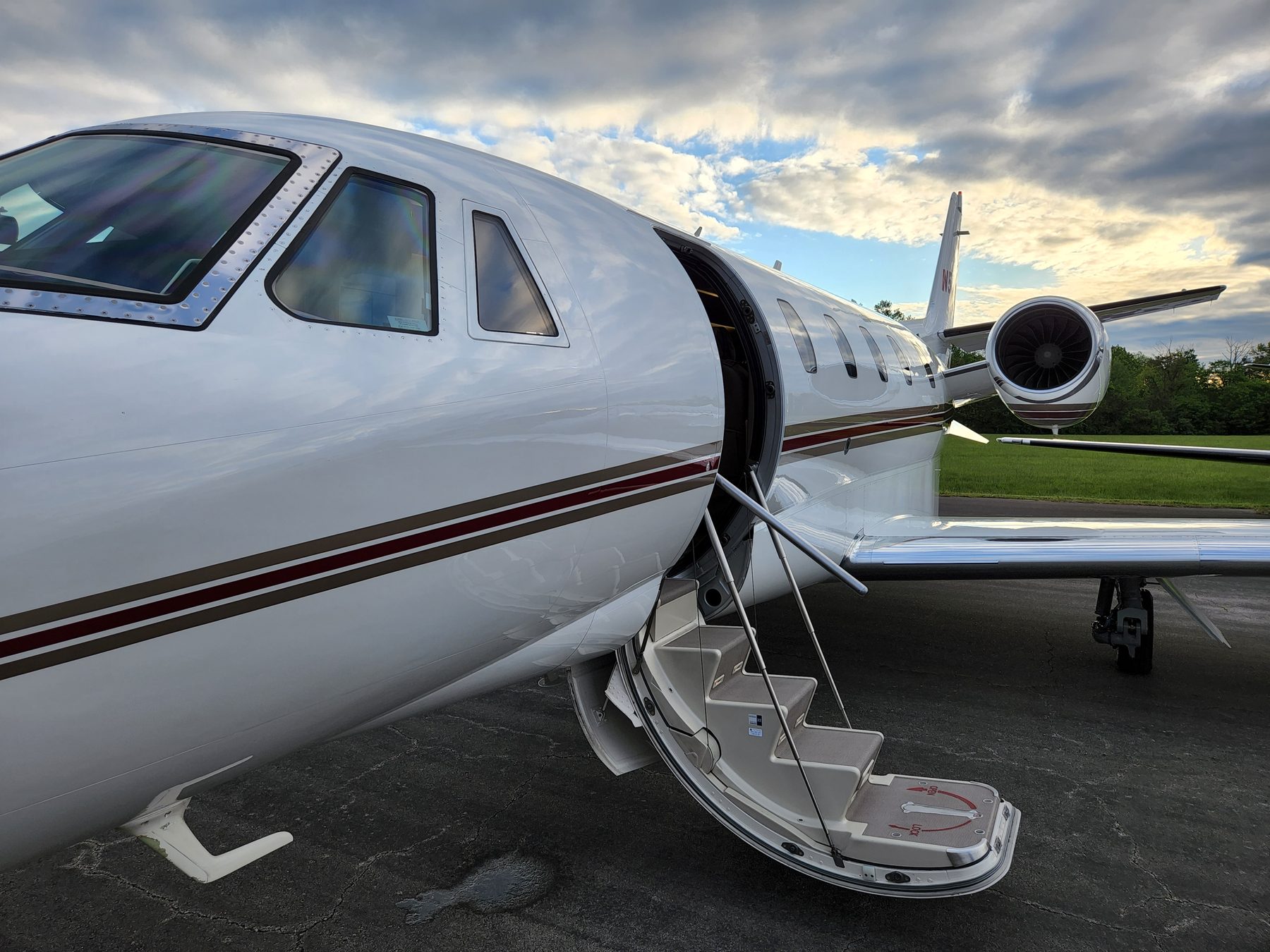
What ownership gives you.
- One aircraft, selected for your mission. You know its condition, capabilities, maintenance history, baggage limits, and cabin — not merely the category promised for the trip.
- A familiar crew environment. The pilots understand the aircraft, its operating history, the airports you use, and the way you and your family travel.
- Control of the schedule. The aircraft is operated around the owner's travel requirements rather than the availability of a third-party fleet.
- A cabin that remains yours. Preferred provisions, car seats, golf clubs, pet arrangements, and other personal items can remain aboard rather than being recreated for every trip.
- Control over maintenance and condition. The owner decides how the aircraft is maintained, improved, presented, and preserved.
- An asset with a market value. Unlike purchased charter or card hours, the aircraft can eventually be sold on the owner's timing and through the open market.
Ownership is not automatically the right answer.
For occasional flying, highly varied missions, frequent one-way travel, or owners who place no value on aircraft and crew consistency, charter or a jet card may remain more economical.
Fractional ownership may also be attractive to travelers who need access across multiple aircraft categories, want extensive fleet redundancy, or prefer to transfer nearly all operational responsibility to a national provider.
The comparison should not be made from an advertised hourly rate alone. It should include the actual trip pattern: repositioning, minimums, overnight charges, peak-day pricing, crew costs, maintenance, fixed ownership expenses, acquisition structure, and expected resale value.
Gateway Jets has a clear bias toward ownership because we manage aircraft. We address that bias by showing owners the full comparison and allowing the mission and numbers to make the argument.
Ownership only works when the operation works.
An improperly selected or poorly managed aircraft can quickly erase the advantages of ownership. Deferred maintenance, inconsistent crews, weak records, reactive planning, and uncontrolled expenses turn a useful business and personal asset into an expensive distraction.
Professional management does not make aviation inexpensive. It provides the planning, maintenance oversight, crew consistency, cost visibility, and day-to-day accountability required to make the ownership model work as intended.
Bring us your recent travel history and actual charter, jet-card, or fractional quotes. We will compare them with a realistic ownership budget built around the aircraft and mission you are considering.